Lifting slings that protect the load and the people under it
Round slings, flat webbing slings and endless slings — made to EN 1492, colour-coded, pull-tested by batch and supplied with the documentation your inspector asks for. Tell us the lift and we will size the sling.
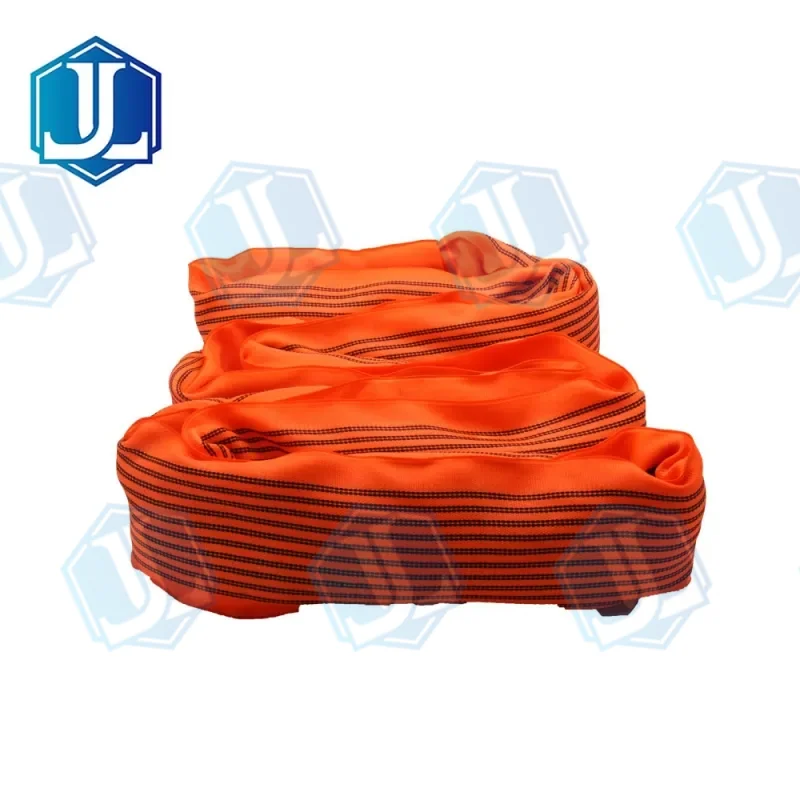
Which sling for which job
All three do the same job with different strengths. The choice usually comes down to the shape of the load and whether the surface must be protected.
Round sling (endless round)
A continuous loop of high-tenacity yarn inside a protective woven sleeve. Soft and supple, it conforms to a load, is gentle on paint and polished surfaces, and carries very high capacities in a light package. Colour-coded to EN 1492-2.
Flat webbing sling
A woven polyester belt with reinforced eyes at each end. Thinner and lighter than a round sling at the same capacity, it is easy to inspect because the weave is visible, and it is the everyday sling for general lifting.
Endless webbing sling
A flat woven belt joined into a continuous loop, with no eyes and no fittings. It rolls onto itself, hugs a load and adapts to whatever angle the lift offers — useful for awkward shapes and for tucking into small gaps.
The colour is the capacity
A worn sleeve fades, and a sling in the wrong colour is a sling being used at the wrong capacity. The colour code exists so a sling can be identified at a glance — but the label is the authority, and it carries the batch number we can trace.
- Colour identifies, the label confirms — read the label before every lift.
- Batch-traced — the number on the label goes back to a pull-test record.
- Above 10 t is normal — capacities beyond the standard table are made to order.
| Colour | WLL | Typical use |
|---|---|---|
| Violet | 1 t | The lightest sling in the range — for small components, tooling and one-man lifts. |
| Green | 2 t | The general-purpose small sling; common in workshops, garages and light installation work. |
| Yellow | 3 t | A frequent choice for site work and small plant where the load is awkward but not heavy. |
| Grey | 4 t | The step up for skips, pumps, motors and mid-weight machinery. |
| Red | 5 t | A workhorse for general lifting and for the smaller wind and heavy-industry components. |
| Brown | 6 t | For construction plant, structural steel and packaged loads. |
| Blue | 8 t | Heavier steel, machinery and the larger fabricated components. |
| Orange | 10 t | The top of the standard colour code — for the heaviest routine lifts in the range. |
Working load limits shown are the standard EN 1492-2 colour code for round slings. Effective length, width and eye type are made to order; higher capacities are quoted on request.
What we mark, and what we test
A sling is a safety device, and the paperwork matters as much as the webbing. Every batch is pull-tested, the result is recorded against the batch number, and the marking on the label is the same number your inspector will look for.
- Working load limit marked on every sling, in the units your market uses.
- Batch pull-test record kept against the batch number on the label.
- Test certificate and declaration of conformity supplied with the shipment.
- Inspection guidance included — the damage that means a sling leaves service.
- Third-party inspection welcome — SGS, BV, Intertek before the container is sealed.
| EN 1492-1 | Flat woven webbing slings made of man-made fibres — the European standard covering the design, marking and testing of our flat and endless slings. |
|---|---|
| EN 1492-2 | Round slings made of man-made fibres — the standard behind the colour code and the capacity marking on our round slings. |
| ASME B30.9 | The US standard for slings, used by North American buyers as a purchasing and inspection reference. |
| EN 818 / grade 80 & 100 | The chain grades used where a lift calls for chain rather than webbing, with the matching fittings and load ratings. |
| Factor of safety 7:1 | Webbing slings are manufactured to a factor of safety of 7:1 on the working load limit, which is the basis of EN 1492. |
Industries that lift with webbing
Webbing slings are chosen wherever the surface must be protected or the load is an awkward shape. These are the five applications we make most often for.
Wind energy & oversize cargo
Wide, soft, high-capacity slings for blades, tower sections and nacelles, where marking the surface or creeping during a road move costs far more than the sling. See the dedicated application page for the full picture.
Marine, yacht & boatyard
Slings that lift a hull or a rigging component without leaving a mark, plus the shackles, thimbles and marine hardware that go with them.
Machinery & plant
Round and flat slings for motors, pumps, skips and machine tools, in the capacities a workshop actually keeps on the rack — plus soft loops where a chain would damage the finish.
Construction & structural steel
High-capacity slings and endless loops for beams and fabricated sections, chosen so the sling conforms to the steel rather than the steel deciding the sling.
Power, transformer & heavy industry
The heaviest lifts in the range, with the documentation, traceability and third-party inspection that utility and EPC buyers require.
The lifting ranges we make
Every family is made in our own factory and can be built to your own specification — length, width, colour, eye type and packing.
Round Sling
Endless round slings with a seamless polyester cover protecting the core yarn — soft, flexible and gentle on painted or polished loads.
9 products →Flat Webbing Sling
Flat woven polyester webbing slings from 1 T to 10 T in single, double and multi-ply construction, colour coded to EN 1492-1 for instant capacity identification.
9 products →Endless Webbing Sling
Endless loop webbing slings for choke and basket hitches where a compact, low-stretch lifting sling is required.
3 products →Marine Hardware
Stainless steel and galvanised marine fittings — boat tie-downs, deck hardware and rigging.
30 products →Rigging hardware
Hooks, buckles, ratchet handles, D-rings, O-rings, wire rope clips and other rigging components.
67 products →Lifting slings — FAQ
What is the difference between a round sling and a flat webbing sling?+
A round sling is a continuous loop of load-bearing yarn inside a woven sleeve, so it is soft, conforms to awkward shapes and is gentle on painted or polished surfaces. A flat webbing sling is a woven belt with reinforced eyes, which is thinner, cheaper for the same capacity and easier to inspect because the weave is visible.
What do the colours on round slings mean?+
The colour of the sleeve is a capacity code, not decoration — it lets a sling be identified from a distance. The code runs from violet at 1 t through green, yellow, grey, red, brown and blue to orange at 10 t. It is worth checking the label as well, because a worn sleeve can fade.
What is the safety factor on your slings?+
Webbing slings are designed and manufactured to a factor of safety of 7:1 on the working load limit, which is the basis of EN 1492-1 and EN 1492-2. Every production batch is pull-tested and the record is kept against the batch number.
Can you make a sling in a non-standard length or capacity?+
Yes. Effective length, width, capacity, sleeve colour and eye type are all made to order. Send the drawing or describe the lift and we will quote it — including capacities above the standard table.
Do you supply slings with a test certificate?+
Yes. Sling batches are pull-tested, the result is recorded against the batch number, and a test certificate and declaration of conformity are supplied with the shipment. Third-party inspection is welcome.
When should a sling be taken out of service?+
Any sling with a cut or frayed load-bearing yarn, a damaged or illegible label, chemical or heat damage, or a distorted or cracked fitting should be withdrawn from service immediately. We supply inspection guidance with the order, and the label carries the batch number so the history can be traced.
Other ways we work with buyers
Request a Quote
Send your specification — width, length, capacity, quantity — and get a price, a lead time and a sample offer within 12 hours.
Get a price →OEM & Private Label
Your brand on the webbing, the label and the carton. Woven-in logos, custom colours and retail packaging from a low trial quantity.
Private-label details →Cargo Control Solutions
Load restraint by vehicle and cargo — flatbed, container, curtain-sider, car carrier and heavy haul — with the standard behind each one.
See the solutions →Tell us what you are lifting
The load, the shape, the surface you must protect and the capacity you need — that is enough for us to recommend the sling, the length and the price.
Every production batch is pull-tested and recorded against its batch number.
Test certificate, declaration of conformity and packing list.