Anchor Chain
Stud link and studless anchor chain in U2 and U3 for ships, and R3, R4 and R5 for offshore mooring — welded, proof loaded, and supplied with mill certificates and class-society certification on request. Also searched as ship anchor chain, mooring chain and anchor cable.
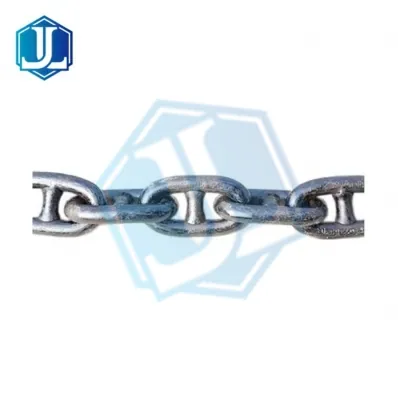
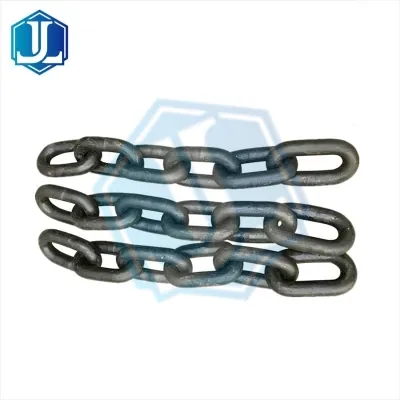
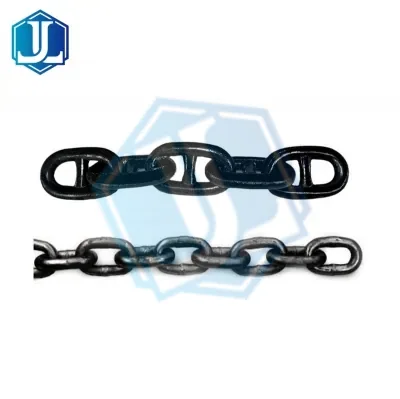
U2, U3, R3, R4, R5 — what the grade changes
The grade fixes the minimum tensile strength of the steel, and that is what decides how much chain you need for a given break load. Ship anchor cable is normally specified as U2 or U3 to ISO 1704; offshore mooring chain is specified in the R grades, where R3, R4 and R5 step up in strength so that a smaller diameter can carry the same load.
| Grade | Where it is specified | Practical effect |
|---|---|---|
| U2 (ISO 1704) | Ship anchor cable, general newbuilds | The workhorse grade — forgiving, and the least expensive per tonne |
| U3 (ISO 1704) | Ship cable where higher strength is wanted | Higher minimum tensile than U2, so a smaller diameter does the same job |
| R3 | Offshore mooring, MODU and FPSO work | First of the mooring grades; typically 690 N/mm² minimum tensile |
| R4 | Deepwater and long-term moorings | Typically 860 N/mm² minimum tensile; smaller diameter for the same break load |
| R5 | High-tension, weight-sensitive moorings | Typically 960 N/mm² minimum tensile; the top of the range |
Stud link or studless
A stud is a bar forged across the inside of the link. It stops the link collapsing and the chain kinking when it goes slack, which is why ship anchor cable is almost always stud link.
Studless chain is cheaper to make, easier to blast and inspect, and it passes more freely over a windlass or fairlead at large diameters. Offshore mooring largely moved to studless for that reason.
| Stud link | Studless | |
|---|---|---|
| Kinking resistance | High — the stud holds the link open | Lower; relies on tension to stay straight |
| Handling on deck | Heavier per link, harder to manhandle | Lighter and easier to move |
| Typical use | Ship anchor cable, hawse pipes | Offshore mooring, large diameters |
What a chain has to arrive with
Chain is bought on documents as much as on steel. A shipment that arrives without them cannot be installed on a classed vessel, no matter how good the links are.
- Mill certificate to EN 10204 3.1 for the steel, with heat numbers traceable to the links
- Proof load record for each length, and breaking test where the specification calls for it
- Dimensional report to ISO 1704 — link dimensions, diameter tolerance, gauge length
- Class-society certificate and stamping (ABS, DNV, LR, BV, NK, CCS) on request
- Marking on the end link: grade, diameter, heat number and class stamp
Matching chain to the anchor, the windlass and the locker
Chain diameter falls out of the same Equipment Number table that fixes the anchor mass, so the two are quoted together — see the anchor page for the formula and the inputs we need.
Length is quoted in shots. A shot is 27.5 m (15 fathoms), and cable is normally supplied in whole shots plus a connecting link, so that it can be joined or replaced a shot at a time.
Tell us the windlass chain wheel size and the locker volume as well. A cable that fits the anchor but not the wildcat is the specification error we see most often.
Finish, corrosion, and what galvanizing does to the diameter
Chain is supplied black, painted or hot-dip galvanized. Galvanizing is the usual choice for a mooring that stays in the water, and it adds a measurable layer to the link. Class rules allow for that layer, but the allowance has to be on the drawing — otherwise the finished chain will not pass the gauge.
Questions buyers ask before ordering
Which grade should I specify — U2, U3 or R3/R4/R5?+
U2 or U3 if this is ship anchor cable and the class table says so. R3, R4 or R5 if it is an offshore mooring and the mooring design calls for it. The grade is set by the class rules or by the mooring analysis, not by preference — send the requirement and we quote the diameter that meets it.
What is a shot of chain?+
27.5 m, or 15 fathoms — the unit cable is ordered in. Cable is supplied in whole shots plus a connecting link, so it can be shortened or repaired a shot at a time.
Can you supply chain with a class certificate?+
Yes, through ABS, DNV, LR, BV, NK or CCS. Certified chain is proof loaded and witnessed, and it takes longer than black chain. Tell us the class at inquiry stage rather than after the order.
Stud link or studless — which do I need?+
Stud link for ship anchor cable and anything running through a hawse pipe, because the stud keeps the chain from kinking when it goes slack. Studless for offshore mooring and large diameters, where it handles better and passes more freely over the windlass.
How do I know the chain diameter matches my anchor?+
Both come out of the same class table. If you already have the anchor mass and its class approval, the table gives the chain diameter; if you have the Equipment Number, both fall out of it. Send whichever you have and we will work back to the other.
How is the chain packed for export?+
In bundles or on pallets, banded and marked with grade, diameter, length and heat number. For a full cable we pack in the shot sequence so the installer can run it out in order.
Other Marine Hardware product groups
Need anchor chain to your own specification?
Widths, lengths, colors, logo printing, hook types and packaging — all made to order. Send your drawing or reference sample.